Owner Financing Requirements in Costa Rica: A Comprehensive Guide
Interest in Costa Rica real estate from international buyers is surging. Foreign investment has jumped over 30% in just three years. Why? This nation is widely seen as one of Latin America’s safest places to own property. Strong legal protections and clear fee simple title rights give foreigners the same ownership security as locals.
We created this guide to be your straightforward educational resource. Our goal is to demystify the entire process—from finding a property to closing the deal. Please note: this is general information, not legal or tax advice. You’ll always need to work with local professionals.
We take a no-suits-and-ties approach. This means practical, transparent guidance from our team, who know this market inside and out. We’ll walk you through critical steps like title review, surveys, zoning, and coordinating with attorneys, notaries, and escrow.
Financing options, including owner financing, do exist here. This guide provides a general overview. For specific loan products and terms, visit gapequityloans.com. Let’s start your journey toward owning a home in this beautiful country.
Introduction to Costa Rica Real Estate Market
The appeal of owning property in Costa Rica extends far beyond its famous beaches and rainforests. We see a clear trend: foreigners are drawn by a powerful combination of stability, opportunity, and lifestyle.
Foreign Buyer Trends and Motivations
Confidence is high. Foreigners receive the same fee simple title rights as citizens. This means complete control over your property. You can sell, lease, or develop it freely.
Political stability and clear laws make this country a safe place for investment. Coastal areas like Samara and Tamarindo show strong rental potential. GAP Real Estate focuses on these investment-ready properties.
The Allure of Costa Rica’s Lifestyle
The “pura vida” lifestyle is a major draw. Year-round warm weather and rich biodiversity create an enviable living environment. A top-ranked healthcare system adds crucial security for families and retirees.
Infrastructure supports modern life. Upgraded highways and reliable internet make remote work easy. This unique blend makes Costa Rica a premier destination for global buyers.
Understanding Owner Financing Requirements in Costa Rica
Navigating purchase options in Costa Rica requires clarity on both financing and legal safeguards. Most transactions here are cash-based, especially for foreign buyers. Local banks typically do not lend to non-residents.
Some sellers, however, offer owner financing as a flexible alternative. We discuss financing generally because specific terms and rates vary widely. For detailed loan options, visit gapequityloans.com.
Overview of Clean Title Reviews and Survey Essentials
Regardless of your payment method, a clean title review is non-negotiable. This process protects your investment. A qualified attorney searches the National Registry (Registro Nacional).
They verify ownership and check for liens, mortgages, or easements. This confirms the legal description matches the physical property. These details form the foundation of a secure real estate purchase.
An official property survey, or plano catastrado, is equally critical. Without a registered survey, a property cannot be legally transferred. Boundary verification prevents future disputes.
We emphasize these requirements from the start. Our team vets investment-ready properties for title clarity and survey accuracy. This ensures a smooth process for your Costa Rica property acquisition.
how-to-buy-a-home-in-costa-ricas-buyers-market: A Step-by-Step Guide
Finding the right home in Costa Rica begins with understanding its decentralized market structure. There is no multiple listing service (MLS) or centralized website like Zillow. Property discovery relies heavily on local connections and knowledge.
Initial Steps: Finding and Vetting Properties
Your first decision is choosing a geographic area. Match your lifestyle goals to regions like Guanacaste’s beaches or the Central Valley’s mountains. This focus streamlines your search.
Next, partner with a reputable local real estate agent. Look for professionals registered with SUGEF, which is required for legal transactions. Affiliations with NAR or CRGAR signal higher standards.
We pre-screen investment-ready properties for fundamental issues. This includes checking title clarity, legal access, and utility availability. Our vetting process saves you time and identifies potential problems early.
Ask critical questions during initial evaluations. Is the title clean? What are the zoning rules? Are utilities connected? Understanding these details is part of a secure purchase process.
Our team guides you through this discovery phase. We combine online resources, local networks, and on-the-ground tours. This approach ensures you see the full range of options in Costa Rica’s unique real estate landscape.
The Costa Rican Property Buying Process: Discovery to Closing
Your property purchase in Costa Rica moves through distinct phases: discovery, offer, due diligence, and transfer. We guide you through each step to ensure clarity and security. This structured process protects your investment from start to finish.
Property Tours and Making an Offer
We begin with detailed property tours. You can visit in person or use our virtual tours, photos, and videos. This helps you evaluate options with confidence.
When you find the right fit, we help craft a competitive offer. This includes a formal Option to Purchase agreement. It outlines the purchase price, a typical 5-10% deposit, and timelines.
Negotiations on price are common here. Your agent’s local knowledge is key for a realistic offer that the seller will consider.
Coordinating Due Diligence and Closing Procedures
Once an offer is accepted, due diligence starts. We connect you with qualified local attorneys. They verify the title, survey, zoning, and all critical property details.
Your deposit goes into a secure escrow account for protection. The final step is closing, handled by a Notary Public. They prepare and register the transfer deed with the National Registry.
We coordinate these moving parts, keeping you informed throughout. Our role is to ensure a smooth process from your initial offer to final property transfer.
Navigating Due Diligence and Clean Title Reviews
The due diligence phase is your strongest shield against future legal troubles when acquiring property in Costa Rica. A clean title review is the most critical component of this process. Cutting corners here can lead to costly problems.
We coordinate with experienced local attorneys to manage this for you. Their deep knowledge is essential for a secure transaction.
Performing a Comprehensive Title Search
Your attorney conducts a thorough title search at the National Registry. They verify the current owner and review the complete chain of title. This search identifies any mortgages, liens, or recorded easements.
The official property report details the exact location, boundaries, and survey number. It lists all recorded documents affecting ownership. Your attorney also checks municipal tax receipts and utility bills.
If the property is held by a corporation, additional due diligence is required. The attorney verifies the entity is in good standing. They confirm the signatory’s authority and require sworn affidavits.
This meticulous process protects your investment. GAP Real Estate facilitates this coordination to give you confidence before closing.
Essential Aspects of Property Surveys, Zoning and Permits
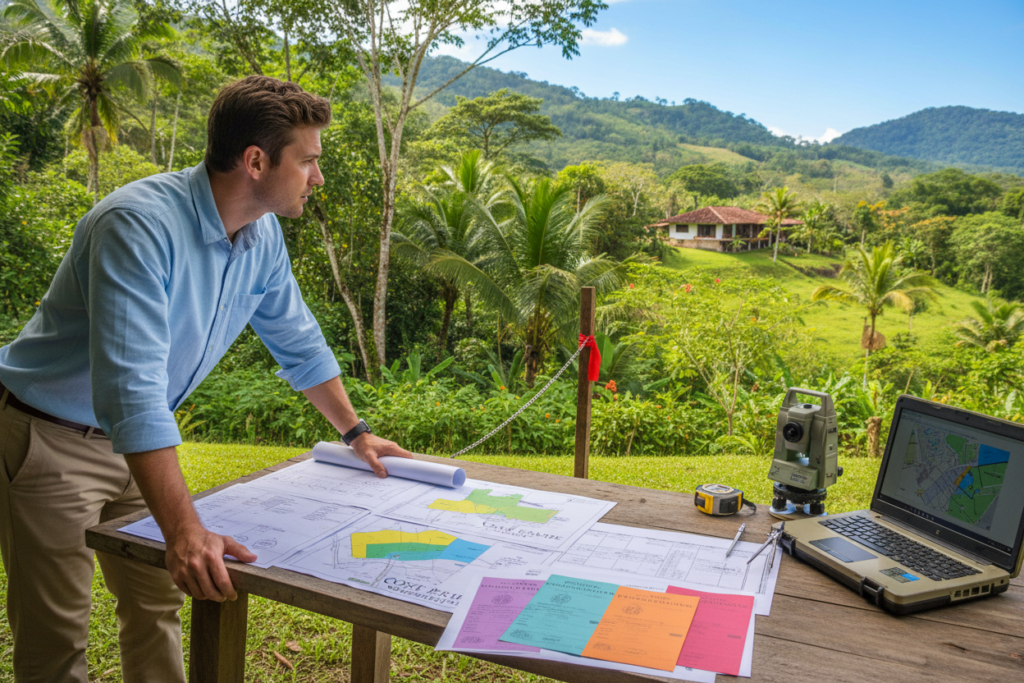
A secure property purchase in Costa Rica rests on three pillars: a valid survey, clear zoning, and a full understanding of any community rules. We help you verify each one.
Understanding Zoning Regulations and Permits
Zoning rules change by municipality and area. A property might be for residential use only. Another could allow a commercial business.
Coastal properties have extra layers of law. The first 50 meters from the high-tide line are public land. The next 150 meters are a restricted zone.
Ownership here often requires a special concession. Your plans may need various permits. These include municipal building permits and environmental approvals from SETENA.
Reviewing HOA/Condo Rules and Boundaries
If you buy in a managed community, review its governing documents carefully. These detail monthly fees, rental policies, and architectural rules.
They can greatly impact your costs and enjoyment. We help gather these essential details during due diligence. Our goal is to ensure you have complete information before you commit.
Legal Considerations and Coordination with Local Pros
Understanding the roles of local professionals is key to a secure real estate transaction. Costa Rica law requires specific experts to handle your property transfer. We coordinate this network to protect your investment.
Working with Attorneys and Notaries
In Costa Rica, only a licensed attorney can act as a Notary Public. This professional does your title search and reviews all legal documents.
They also prepare the purchase agreement and advise on ownership structure. Ultimately, they draft and register the transfer deed with the National Registry.
We connect you with responsive, English-speaking attorneys we trust. This ensures clear communication and proper due diligence.
Utilizing Escrow Services and National Registry Processes
Using a licensed escrow service is crucial. These companies are regulated by SUGEF and hold funds securely until closing conditions are met.
They require identification, proof of funds, and a completed “Know Your Customer” form. Typical escrow costs range from $600 to $1,000 plus tax.
After closing, your notary submits the deed to the registry. The registry reviews it and records the new ownership. We facilitate this entire process, keeping all parties on timeline.
Our coordination ensures nothing gets delayed. You gain confidence that your property transfer is handled correctly under Costa Rican law.
Investment and Buyer Education in the Costa Rican Market
Smart investment in Costa Rica starts with a foundation of clear, unbiased education. Our core mission at GAP Real Estate is to empower you with knowledge. We provide transparent information so you can make confident decisions about real estate here.
Assessing Investment-Ready Properties
We identify investment-ready properties through rigorous preliminary vetting. This means confirming a clean title, proper surveys, and clear zoning. We also verify legal permits, utility access, and realistic pricing.
Location is a primary driver of appeal. Areas like Samara, Nosara, and Tamarindo attract consistent tourist and expat demand. This creates opportunities for both short-term and long-term rental income.
Understanding potential is key, but we avoid specific return guarantees. Outcomes depend on purchase price, management efficiency, and market conditions over the years. Serious buyers ask about occupancy rates, comparable rents, and all ongoing costs.
Our education extends beyond the purchase. We help you understand property management and tax obligations. The goal is to make you a knowledgeable buyer who sees both the opportunities and practical realities of owning property in Costa Rica.
Key Factors for a Successful Purchase: Utilities, Road Access and Taxes
A successful property purchase in Costa Rica hinges on verifying practical details before closing. We help you confirm three critical elements: reliable utilities, legal road access, and a full understanding of all costs.
Reviewing Municipal Taxes and Ownership Structures
Closing costs here typically range from 3.5% to 4% of the purchase price. This includes a 1.5% transfer tax, 0.84% for registration stamps, and around 1.25% in legal fees.
Annual property taxes are a major advantage. They are only 0.25% of the property’s registered value. For a $400,000 property, that’s just $1,000 per year.
Many buyers choose to hold title through a local corporation. This offers benefits like simplified transfer and estate planning. Forming a new entity costs about $650.
We verify utility connections and legal road easements during due diligence. Our coordination ensures no surprises with access or ongoing fees after you commit.
Realistic Timelines and Expectations for a Smooth Transaction
The pace of completing a property purchase in Costa Rica often surprises international buyers accustomed to faster processes. We set clear expectations from the start. A typical transaction here takes 30 to 60 days from accepted offer to final closing.
This timeline depends on due diligence complexity. Since most deals are cash-based, you avoid lender delays. Many closings happen in just over a month.
Planning for a Flexible Closing Schedule
Delays are common. Waiting for seller documents or attorney reviews can extend the process. Your purchase agreement should include a target date with flexibility for reasonable extensions.
Patience is key. Costa Rica operates on “tico time,” where bureaucratic steps have their own pace. Building buffer time into your schedule prevents stress.
After closing, the notary submits the deed to the National Registry. Official recording takes an additional two to three weeks. We coordinate with all parties to keep your transaction moving smoothly toward completion.
Tips for Selecting Trusted Real Estate Agents and Lawyers
In a market where agent licensing isn’t mandatory, vetting your professional partners becomes your first critical task. The right team makes your transaction smooth and secure.
Evaluating Agent Experience and Local Expertise
Always verify a SUGEF registration. This is the legal minimum for handling funds. Look for agents affiliated with NAR or CRGAR for higher ethical standards.
Seek an agent with years of local experience. They should know your target area intimately. Ask about their transaction history and if they own property there.
A quality agent shows you all suitable listings, not just their own. They provide honest assessments and maintain strong local connections. Good communication is essential.
Choosing a Responsive Lawyer for Due Diligence
Your attorney must be fluent in English and specialize in real estate. General legal practice isn’t enough for Costa Rica property deals.
Responsiveness is a key trait. They should explain complex issues clearly and provide a timeline. Avoid attorneys who are slow to communicate or vague.
At GAP Real Estate, we leverage our years of experience and local network. We connect you with proven, responsive attorneys. This ensures your due diligence is handled by experts you can trust.
Final Steps: Connecting with GAP Real Estate for Expert Guidance
Taking the final step in your Costa Rica property purchase means connecting with a team that prioritizes your education and success. This guide has shown that a secure transaction requires thorough due diligence and expert local coordination.
Our mission at GAP Real Estate is to provide that clarity. We educate buyers, vet investment-ready properties, and manage the entire process. We connect you with trusted attorneys, notaries, and escrow services.
Our approach is transparent. We offer information and guidance, not unrealistic guarantees. We help you ask the right questions to make confident decisions about your real estate purchase.
Ready to begin? Contact us today via WhatsApp at +506 4001-6413 or call toll-free from the USA/Canada at 855-562-6427. You can also visit gaprealestate.com to explore listings.
With the right partner, your goal of owning property in Costa Rica is within reach. Let’s start your journey.
FAQ
What exactly is owner financing, and is it common in Costa Rica?
What are the most critical steps in the due diligence process?
How do closing costs work, and who typically pays for what?
Do I need a local attorney, and what should they handle?
What should I look for when choosing a real estate agent?
What are the ongoing costs after I purchase a home?
How long does the entire purchase process usually take?
Can foreigners own property outright in Costa Rica?
More to Explore