
Navigating the Mortgage Process in Costa Rica: A Comprehensive Guide
More international buyers are discovering Costa Rica. Foreign investment in its real estate market has surged over 30% in recent years. This reflects a growing global interest in the country’s beauty, stability, and investor-friendly laws.
Navigating a property purchase here, however, requires specific local knowledge. That’s where we come in. This resource from GAP Real Estate is designed for your education.
Please note: this is informational content only. It is not legal or tax advice, and it is not an offer. Our mission is to simplify and educate.
We’ll walk you through the full journey. That includes initial discovery, vetting properties, and coordinating tours. We cover offer guidance and working with local attorneys, notaries, and escrow services.
Buying property in Costa Rica as a foreigner is absolutely possible and legally protected. The process does differ from what you may know in the U.S. We’re here to break it down in plain language.
This guide covers key areas. You’ll learn about the market landscape, essential due diligence like title review, and financing realities. We’ll also explain legal procedures, documentation, taxes, fees, and ownership structures.
With the right local expertise, the mortgage and purchase process becomes manageable. The reward is owning a piece of one of the world’s most beautiful and stable countries.
Understanding Costa Rica’s Real Estate Landscape
The real estate market in Costa Rica is shaped by diverse factors that influence value and demand. You’ll find opportunities across beachfront, mountain, urban, and rural properties.
Market Trends and Opportunities
Location is paramount for property value. Beachfront areas in Guanacaste or Jaco command premium prices. Urban centers in the Central Valley also hold strong value.
Infrastructure development boosts appeal. Improved roads, airports, and utilities drive demand and prices higher in this dynamic market.
Tourism is a major engine. Thriving areas like Samara and Tamarindo attract vacation rental investors seeking income potential.
Neighborhood Insights and Location Value
Property type influences market positioning. Single-family homes, condos, and commercial assets each have unique value drivers.
Construction quality offers peace of mind. Premium materials and finishes lead to lower depreciation over time.
The residential real estate market is projected to grow at 3.88% annually through 2029. This signals sustained opportunity for savvy investors.
We help you navigate this landscape. We highlight investment-ready properties and provide neighborhood insights so you can make informed decisions without hype.
Key Steps in the Mortgage Journey
We break down the mortgage and acquisition process into actionable steps. This provides a clear roadmap for success in Costa Rica.
Discovery, Vetting, and Property Tours
Our journey starts with discovery. We help you identify properties that match your investment goals and budget.
Next, we pre-screen and vet options. This highlights investment-ready real estate with detailed insights on location and value.
Then, we coordinate property tours. Visiting in person lets you assess the land and feel the area firsthand.
Offer Guidance and Due Diligence Coordination
Once you choose a property, we help structure a competitive offer. This is formalized with an Option to Purchase agreement.
A 5-10% deposit is typically held in escrow. This reserves the property during the crucial due diligence phase.
We coordinate with local attorneys and notaries. They verify the title, survey, permits, and utilities before you commit.
Navigating this process means managing financing and legal transfer together. We keep both tracks moving forward. Expect this phase to take 30 to 60 days or more.
Navigating the Mortgage Process in Costa Rica: What to Expect
The financing landscape for property purchases in Costa Rica operates differently than many expect. If you’re coming from the U.S. or Canada, set realistic expectations early.
Traditional bank financing for foreign buyers is challenging here. Even with strong financials, approval from Costa Rican banks can be elusive. Most transactions are cash purchases or involve private agreements.
Alternative financing options exist. These include international lenders, seller financing, and developer arrangements. Terms and requirements vary widely.
We provide educational guidance on the purchase process and coordinate due diligence. However, we do not offer specific loan advice. For detailed financing inquiries, connect with specialists at gapequityloans.com.
Whether you pay cash or use financing, the due diligence steps remain critical. Title verification, survey checks, and zoning compliance must be confirmed before closing.
Navigating this process is manageable with the right team. We’ll guide you through financing considerations, legal procedures, and documentation in the sections ahead.
Essential Due Diligence: Titles, Surveys, and Boundaries
A secure property purchase in Costa Rica rests on two pillars: a clean title and an accurate survey. This due diligence is the foundation for a safe investment.
Clean Title Review and Survey/Plano Importance
Your attorney conducts a comprehensive title search at the National Registry. This verifies the seller legally owns the property. It also confirms there are no liens, mortgages, or legal disputes attached.
Title issues are more common in the Costa Rican property market than in some other markets. Unpaid debts or inheritance disputes can surface. That’s why working with a qualified local attorney is essential.
The official surveyed map, or plano catastrado, is verified by Catastro Nacional. It defines the legal boundaries of the land. Buyers typically need two verified copies as part of the process.
Always conduct a physical site visit to walk the property lines. Check for encroachments and confirm boundary markers. This step prevents costly disputes after purchase.
We coordinate with trusted local professionals. We ensure the title review and survey verification are complete before closing. This gives you confidence that your property rights are secure.
Exploring Mortgage and Financing Options
Understanding your financing choices is a crucial step when considering property in Costa Rica. It’s important to set realistic expectations. The financing options available to foreign buyers are more limited than in many other countries. A significant portion of purchases are completed with cash.
Fixed and Adjustable-Rate Mortgage Insights
Mortgage products generally fall into two main categories. Fixed-rate mortgages offer payment stability. Your interest rate remains consistent for the entire loan term.
Adjustable-rate mortgages often start with lower initial rates. These rates can fluctuate over time based on market benchmarks. Each type involves a trade-off between predictability and potential initial cost savings.
General Financing Options and Alternatives
Some Costa Rican banks offer financing, including government-backed programs. Approval for foreigners varies and requires extensive documentation. International lenders specializing in overseas property are another avenue.
Seller financing, where the seller acts as the lender, is common here. Developer financing for new projects is also an option. Interest rates and loan terms vary widely based on the lender and your qualifications.
We provide educational guidance on the purchase process. For detailed information on financing options available, connect with specialists at gapequityloans.com. Remember, whether you finance or pay cash, the essential due diligence steps remain the same.
Local Legal Procedures and Closing Requirements
Finalizing a property purchase in Costa Rica involves specific legal steps that ensure a secure transfer. Every transaction must go through a licensed Notary Public. In Costa Rica, a Notary is a certified attorney with special authority.
The Notary prepares the property transfer deed, known as the escritura. They verify identities, witness signatures, and collect transfer taxes and fees. They then submit the deed to the National Registry for official recording.
Coordinating with Attorneys, Notaries, and Escrow
We strongly recommend hiring your own qualified real estate attorney. This professional represents your interests. They conduct due diligence, review contracts, and verify the title and survey.
Funds are typically held in a secure escrow account. The money is released only after all conditions are met. This protects both buyers and sellers during the closing process.
The final requirements include signing the deed in front of the Notary and paying all closing costs. You’ll receive confirmation once the deed is registered in your name.
Our role at GAP Real Estate is to coordinate this entire process. We connect you with trusted local attorneys, notaries, and escrow services. We manage communication to ensure all legal requirements are met on time.
Expect the legal procedures and closing to take 30 to 60 days. Complex cases may take longer. Patience and a strong local team are key to a smooth closing in Costa Rica.
Documenting Your Property Purchase
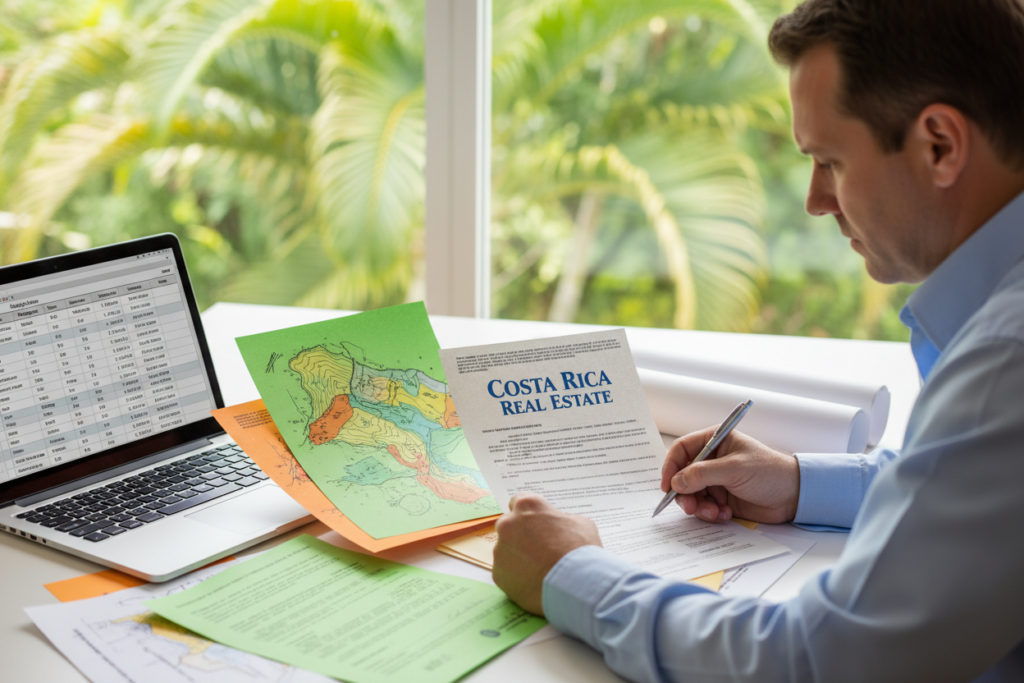
The paperwork phase is where many property transactions either gain momentum or face unexpected delays. Thorough documentation is required for both the legal transfer and any financing. Getting it right from the start ensures compliance and prevents last-minute hurdles.
Required Documentation and Verification Steps
Buyers must gather core personal and financial paperwork. This includes a valid passport, proof of your current address, and bank statements from the last 6-12 months. Proof of income, like tax returns or employment letters, is also standard.
Property-specific documents are equally critical. You’ll need the signed purchase contract, two verified copies of the official survey, and a tax certification. Your attorney obtains title documents from the National Registry for review.
If you are securing financing, expect additional requirements. Lenders may ask for credit reports, proof of other assets, and insurance policies. All foreign documents often need certified Spanish translation and apostille.
Verification is the key step. Your attorney cross-references every document with official registries. They confirm accuracy and ensure nothing is missing before closing.
We provide a clear checklist early on. Our team coordinates with your attorney and notary to keep the paperwork complete and your transaction on track.
Understanding Zoning, Permits, and Condo/Homeowner Rules
Zoning laws and community rules form a hidden layer of property ownership that many buyers discover too late. These regulations determine what you can and cannot do with your asset. Violations can lead to fines or forced changes.
Zoning and Permit Considerations
Properties in Costa Rica are zoned for specific uses. Common types include residential, commercial, and agricultural. You must confirm the zoning matches your intended use before buying.
Special conditions apply near the ocean. The first 50 meters from the high-tide line are public land. The next 150 meters are a restricted zone.
Ownership here often requires a local corporation. Building permits are mandatory for new construction. Always verify that existing structures have proper approvals.
HOA and Condo Regulations Explained
Many properties are part of a homeowner association. Condos and gated communities have strict rules. These govern architectural changes, rentals, and pet policies.
Monthly fees and special assessments impact your budget. Review the HOA’s financial health and bylaws during due diligence. This prevents surprises after you close.
We help coordinate this essential verification. Our team obtains zoning confirmations and HOA documents. We connect you with your attorney to review all conditions.
Budgeting for Taxes, Fees, and Ownership Structures
Smart budgeting for your Costa Rica property investment requires a clear understanding of all associated taxes and fees. Your financial plan must look beyond the listed purchase price. This prevents surprises and ensures sustainable ownership.
Expect significant one-time costs at closing. The transfer tax is 1.5% of the property’s purchase price or registered value. Total closing costs typically range from 3.5% to 4% of the value.
These closing costs cover legal fees, notary services, and registration. Your attorney will provide a detailed breakdown before you finalize the deal.
Ongoing costs include the annual property tax. This municipal tax is just 0.25% of the registered value. You must also consider potential capital gains tax if you sell for a profit later.
A key decision is your ownership structure. You can hold the asset in your personal name or through a local corporation. Corporate options, like an S.A., offer benefits such as liability protection and easier transfer.
They are required for certain maritime zone properties. Each structure has different legal and tax implications.
We provide this educational overview to help you budget realistically. Always consult your local attorney and tax advisor for guidance tailored to your situation. Account for all costs—from the purchase price to annual fees—for a smooth process.
Navigating International Financing and Transfer Options
For many foreign buyers, securing financing and moving funds internationally are the most daunting aspects of acquiring property in Costa Rica. With the right approach and partners, however, buyers successfully complete these transactions every day.
Most foreign buyers either pay cash or work with international financing sources. These lenders specialize in overseas property and are often more accessible than local banks. Their rates and terms can vary widely.
Alternative financing structures are also common. Some buyers leverage equity from a home-country property. Others use retirement funds through self-directed IRAs, which have strict investment-only rules. Seller or developer financing remains a popular option in Costa Rica.
We provide educational guidance on the purchase process. For detailed information on financing options available in Costa Rica, including current rates and terms, connect with specialists at gapequityloans.com.
Moving large sums for a down payment or purchase requires secure, transparent methods. Use reputable transfer services that offer real mid-market exchange rates and clear fee structures.
Consider opening a Costa Rican bank account after you buy. It simplifies paying property taxes, HOA fees, and utilities. It also helps manage local transactions without repeated international transfers.
Always coordinate fund transfer timelines with your attorney and notary. Delays can disrupt closing schedules. Proactive communication ensures your money arrives exactly when needed.
Engaging with Local Pros for Survey and Utility Checks
Before finalizing any property purchase, verifying water sources and legal access is non-negotiable. This due diligence is just as critical as the title review.
Assessing Water Sources, Easements, and ROW Details
Confirm the water source. Is it a municipal AyA connection, a private well, or delivery? Request a water availability letter from the local utility.
Check for recorded easements and rights-of-way. These legal agreements guarantee permanent access. Without them, a property can become landlocked.
Verify utility connections for electricity, internet, and sewer systems. Rural properties may need off-grid solutions like septic tanks and solar power.
Assess the physical road condition. A legal right-of-way is useless if the road is impassable during the rainy season.
We coordinate with local surveyors and engineers. Our team obtains the necessary documentation and confirms everything is compliant. This protects your investment and prevents future headaches.
Buyer and Investor Education with GAP Real Estate
At GAP Real Estate, we believe informed buyers make the best decisions. Our core mission is investor and buyer education. We equip you with knowledge and local connections for confident choices in Costa Rica real estate.
Tips for Foreign Buyers and Investor Preparedness
Start by researching regions and property types. Understand what fits your lifestyle and investment goals. Visiting in person is always best for a true feel.
Assemble your professional team early. This includes a reputable agent, a qualified Costa Rican attorney, and a certified notary. They protect your interests throughout the process.
Budget conservatively for all costs. Account for the purchase price, closing fees, taxes, and ongoing maintenance. Real estate investment carries inherent risks and rewards.
We highlight investment-ready properties based on solid analysis. We never make ROI guarantees or performance claims. Your success depends on thorough due diligence.
Plan for a realistic timeline. Buying property in Costa Rica often takes 30 to 60 days or more. Do not finalize personal plans until the deed is registered.
Remember, we provide educational information only. This is not legal or financial advice. Always consult licensed professionals for your specific situation.
Embracing the Casual Costa Rican Business Culture
The ‘Pura Vida’ lifestyle that draws people to Costa Rica also defines its approach to business. This relaxed, relationship-focused ethos shapes every transaction. Understanding it is key to a smooth property journey.
Local Communication and Relaxed Timeline Insights
Costa Rican professionals value warm, personal connections. Meetings are friendly and often informal. You will rarely see suits and ties here.
This casual style extends to timelines, known locally as “Tico time.” Government offices and banks operate at a more relaxed pace. What takes a week elsewhere can take a month in this beautiful country.
Delays are normal and not a sign of trouble. Building extra time into your plans is wise. Patience and polite persistence work better than urgency.
We act as your cultural bridge. We manage expectations and follow up diligently within local conditions. This ensures your transaction moves forward steadily.
Embracing this pace turns potential frustration into part of the adventure. You can enjoy the process while your property goals are achieved.
Final Thoughts for a Seamless Real Estate Purchase in Costa Rica
Achieving a seamless real estate purchase in Costa Rica is within reach when you leverage local expertise. Foreign buyers have driven investment growth over 30% in recent years.
Your success requires thorough due diligence, realistic budgeting, and patience. The process is manageable with a qualified team—including a local attorney and notary.
We at GAP Real Estate provide educational guidance and coordinate your journey. We highlight investment-ready properties and connect you with trusted partners. Our mission is informational; we offer no guarantees.
Ready to explore? Contact us on WhatsApp at +506 4001-6413, call toll-free at 855-562-6427, or visit gaprealestate.com. With the right support, buying property here can be a rewarding investment for years.
FAQ
What financing options are available for foreign buyers in Costa Rica?
Foreign buyers have several financing options available. These include mortgages from private banks, developer financing, and equity-based loans from private lenders. The Costa Rican real estate market also sees many all-cash purchases. Each option has different requirements for documentation, down payment, and proof of income.
What are the typical closing costs when buying property?
Closing costs in Costa Rica typically range from 3.5% to 4.5% of the purchase price. These fees cover transfer tax, legal and notary fees, and the national registry registration. It’s a key part of budgeting for your investment. We always provide a detailed estimate early in the process.
How important is a title search, and what does it involve?
A clean title is the absolute foundation of a secure property purchase. The title search verifies the seller’s legal ownership and checks for any liens, encumbrances, or legal issues. This due diligence is non-negotiable and is coordinated by your attorney. It protects your investment.
Can I get a traditional mortgage from a Costa Rican bank as a non-resident?
Yes, but the process can be stringent. Private banks may offer mortgages to foreign buyers, but they require extensive financial documentation, proof of stable income, and often a larger down payment. Approval timelines can be longer than in North America. Exploring all financing options available is wise.
What is the role of a notary public in the closing process?
In Costa Rica, a notary public is a licensed attorney who plays a central legal role. They prepare the transfer deed, ensure taxes are paid, and register the property at the National Registry. You’ll work closely with your chosen notary to finalize the sale and secure your title.
Are there property taxes I should know about as an owner?
Yes. The main annual property tax is very low, typically 0.25% of the declared property value. There’s also a luxury tax on higher-value homes. Understanding these ongoing costs is part of our buyer education, helping you plan for the full cost of ownership.
What should I look for in a property survey or "plano"?
A registered survey, or plano, is crucial. It confirms the exact boundaries and size of the land. Your due diligence should verify that this plano matches the physical markers on-site and the description in the title. This step prevents future disputes over property lines.
How long does the purchase process usually take from offer to closing?
With all documentation in order, the process from accepted offer to closing typically takes 30 to 45 days. However, Costa Rican business culture operates on a more relaxed timeline. We build realistic schedules and manage communication to keep things moving smoothly toward your closing date.